Most mattress advice on the internet was written for cold-country bedrooms. Sleep researchers in the United States recommend a bedroom temperature of around 18°C (65°F). For most of the year in Colombo, Kandy or Galle, that figure is a fantasy. The bedroom is closer to 27–29°C, the humidity is sitting above 75%, and a ceiling fan is doing its honest best. That changes what a mattress needs to do.
The problem: heat trapped at the sleep surface
When you lie down, two things happen. Your body radiates roughly 70–100 watts of heat. The mattress traps a thin envelope of air around you. In a cool, dry bedroom that envelope vents through the cover and dissipates. In a tropical bedroom the envelope simply gets warmer, the humidity rises, and you wake up at 2am wondering why the fan stopped working. The fan didn't stop working. The mattress did.
Cooling, then, isn't a magic feature. It's the deliberate management of three things: how heat conducts away from your skin, how moisture wicks out of the sleeping layer, and how air moves through the core of the mattress.
What "cooling" actually means on a spec sheet
A few terms you will see repeated across mattress listings and marketplaces in Sri Lanka:
Cooling gel-infused foam
Memory foam is famously good at conforming and famously bad at venting heat. Manufacturers infuse it with gel particles (or apply a gel layer on top) to raise its thermal conductivity. The effect is real but modest: you feel cooler-to-the-touch for the first several minutes, after which the layer reaches body temperature. Gel-infused foams work best when paired with an airflow layer underneath, which is why most mid-tier and premium mattresses pair them with pocket springs.
Pocket springs
Each spring is individually encased in fabric, so they move independently and create channels of air through the mattress. This is the single most important cooling feature in a hot climate. Solid foam mattresses (without springs) almost always sleep warmer in the tropics, no matter how many cooling-gel layers are bolted on top.
Knitted, jacquard, or "Tencel" covers
The fabric on the very top of the mattress matters more than people think. Tightly woven covers trap heat and moisture. Open-knit covers let both escape. Tencel and bamboo-derived fibres wick moisture better than pure polyester. Anti-microbial finishes are useful in our humidity because they slow the growth of mould and dust mites, which thrive between 20–30°C and 70–80% humidity (the conditions in your bedroom right now).
Phase-change materials (PCM)
You will sometimes see "Outlast" or "PCM" mentioned in premium imports. These are micro-encapsulated waxes that absorb body heat as they change state. They work in cool climates by buffering temperature swings. But in Sri Lanka, once they have absorbed their thermal load (typically two to three hours into the night), they sit fully charged and stop helping until you cool the room. Useful, but not the headline feature it is sold as in Europe.
Firmness for a humid climate
The global consensus from orthopaedic research over the past two decades is that medium-firm mattresses produce the best long-term outcomes for back pain and sleep quality for most adults. (See, for example, the Kovacs et al. trial published in The Lancet, which has been replicated several times since.) That recommendation still holds in Sri Lanka. The local twist is that humidity makes you sweat more, so a very plush, deep-conforming mattress will trap more heat against your body. A medium-firm surface keeps less of you in contact with the bed, so less heat builds up against you.
How Sri Lankan mattress quality compares globally
Sri Lanka does not yet have a published national standard specifically for mattresses, so buyers usually have to read the spec sheet themselves. Useful global reference points:
- Comfort-foam quality: Ask whether the comfort layer is a durable-grade foam rather than a cheap filler: better foams hold their shape for years, while the cheapest soften within two to three. Gel-infused or higher-resilience foams are a good sign in our climate.
- Spring system: Look for individually-wrapped ("pocketed") springs rather than a single connected coil unit: they move independently, so you feel less of a partner turning over. Zoning, where the springs are tuned firmer under the hips and lower back, matters more for everyday comfort than the raw coil count a brochure quotes.
- Cover wash certification: OEKO-TEX Standard 100 certification on the cover fabric means it has been tested for harmful substances, a useful baseline if young children will use the bed.
- Warranty length: 10 years against manufacturing defects is the global market norm for pocket-spring mattresses (Sealy, Tempur, Silentnight and most reputable manufacturers offer this). Significantly shorter warranties (under five years) are a quality signal worth questioning.
A short Sri Lankan buyer's checklist
- Confirm the build: ask for the layer-by-layer construction in writing. "Cooling foam" with no spring core, in our climate, is rarely worth the price.
- Ask about the comfort foam. A durable-grade or higher-resilience foam in the comfort layer; steer clear of cheap fillers that soften within a couple of years.
- Check the cover. A breathable knit that wicks heat and moisture beats a tightly-woven damask, which looks luxurious but traps heat. A spill-resistant or water-resistant finish is worth having in a humid climate where mattresses rarely get aired properly.
- Confirm warranty terms. Specifically: what counts as a defect, what voids the warranty (no slatted base, stains, etc.), and how a claim is processed.
- Sit and lie on the bed if you can. The single most reliable test, in any climate, is fifteen minutes on the mattress in the position you actually sleep in. If buying online, check the return policy carefully: most reputable brands accept returns on unopened mattresses within 7–14 days.
How we built the KIRA Sunrise
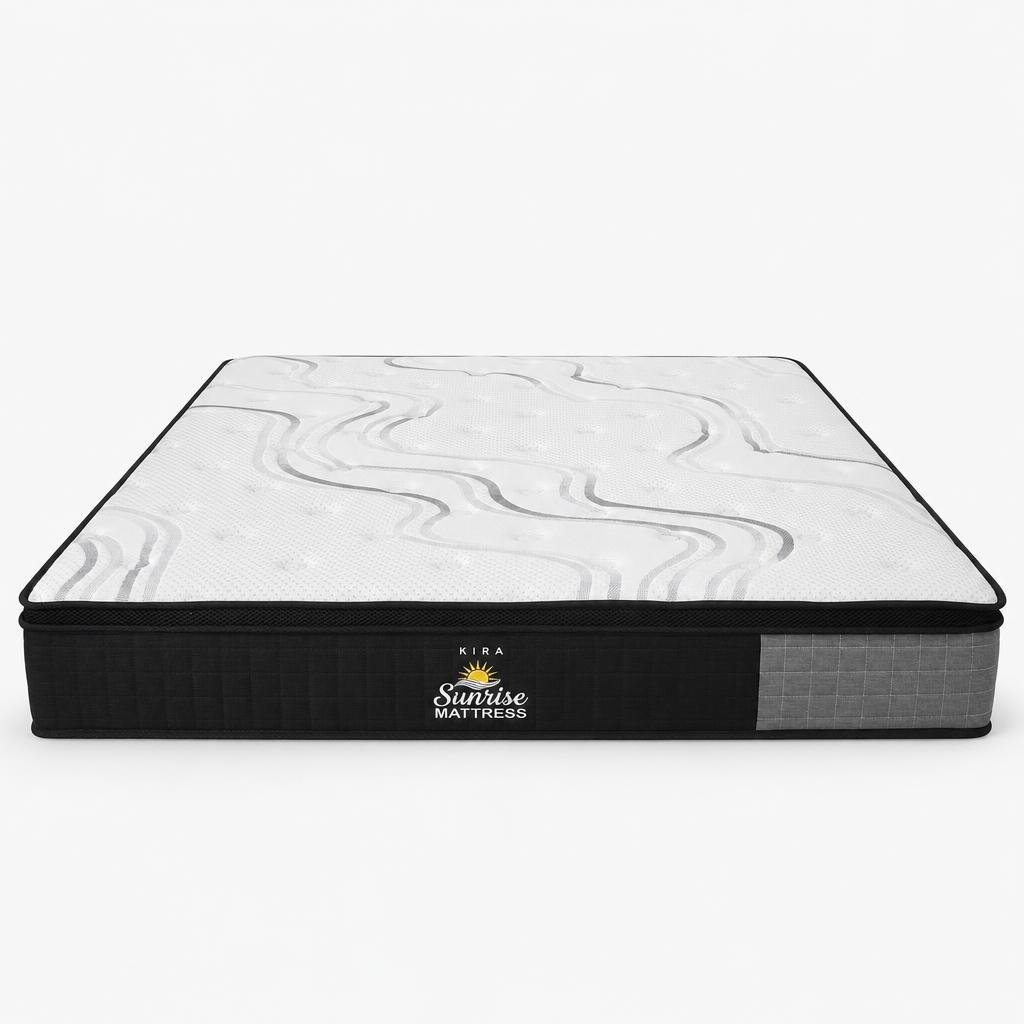
The KIRA Sunrise Mattress is the answer we arrived at for Sri Lankan bedrooms: a water-resistant cool-touch cover that wicks heat and moisture as you settle in, cooling gel memory foam that contours to shoulders and hips, a 5-zone pocket-spring core that moves air instead of trapping it (and holds your spine in a neutral line while it does), and edge-to-edge reinforced support. It stands 30cm tall with a medium-firm feel on the firmer side (about 7 / 10). The whole build is about moving heat and moisture away from your body rather than holding it against you.