A headboard started out as insulation: something soft between a sleeping head and a cold wall. In a Sri Lankan bedroom the cold is not the problem, but the wall still is. It marks, it is hard to lean on, and in a rented flat it is not yours to change. An upholstered headboard solves all three, and the good ones are chosen the way you would choose a chair.
A backrest, not a backdrop
Ask yourself what you actually do in bed before you fall asleep. If the answer includes reading, scrolling, a laptop or an hour of television, you are not buying decoration. You are buying a backrest that happens to be attached to a bed.
That changes what "good" means. A headboard padded too softly feels lovely for the first ten seconds and then collapses, and you end up propping pillows in front of it, which is a quiet admission that the headboard failed. One padded firmly, over a solid backing, holds you at a comfortable angle for an hour without giving way.
The test, if you can get your hands on one: press your palm into the centre and lean your weight in. It should compress a little and then stop. If your hand keeps travelling, the padding is there to look plump rather than to hold a person.
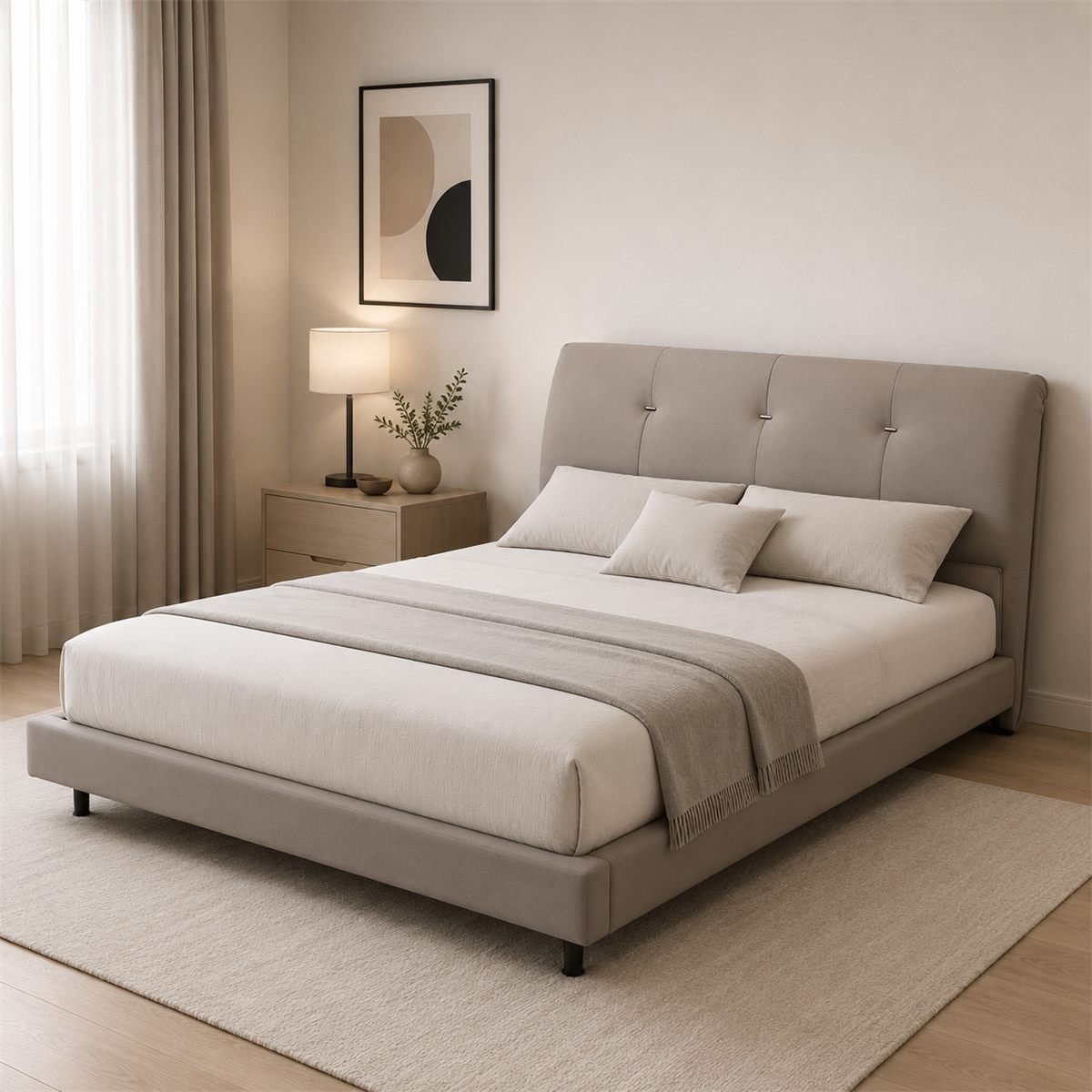
Height, and the mattress that eats it
Here is the mistake that catches almost everyone buying online: a headboard's height is measured from the floor, but what you see is only the part above the mattress.
Put a tall mattress on the frame and the visible headboard shrinks. Our own Sunrise mattress stands 30cm, roughly the hotel profile, and that is a lot of height to give up. A headboard that looked generous in the photograph, shot with a thin mattress, can end up looking like a low ledge in your room.
So work it out before you order: headboard height, minus mattress height, minus the frame's deck height is what will actually show. Then look at the wall. A tall headboard suits a high ceiling and a plain wall, and gives a small room a sense of deliberate scale. A lower one suits a window behind the bed, a cornice, or a room that already has a lot going on.
Three shapes, and how they age
Tufting is not only pattern. It changes how the padding behaves and how the piece reads across a room.
Vertical channels run floor-to-top in soft columns. They draw the eye upward, which makes a bedroom feel taller, and they suit a plain wall with something to prove. Because the padding runs in unbroken lines, the surface stays even where you lean. This is the tallest, most architectural of the three.
Channels with buttons keep those columns but pin them at intervals, which breaks up the height and softens the whole piece. It is the gentlest of the three, and the one that sits most quietly in a room that already has pattern in the curtains or the floor.
Square-button tufting is the classic grid: the most formal, the most traditionally "bed-like", and the one that reads as tailored rather than soft. It is a good choice when the rest of the room is modern and you want the bed to be the grown-up in it.
One honest word about buttons. Buttoned tufting has small recesses, and recesses collect dust. It is a minute with a vacuum brush rather than a real chore, but if nobody in your house will ever do that minute, unbroken channels are the easier life.
What is behind the upholstery
Upholstery is the part you see. The part that decides whether the bed is still solid in year eight is underneath it.
Ask about the weight rating, which tells you what the frame was engineered for rather than what it can survive once. Ask about the slats: gaps wider than about 7cm let a pocket-spring mattress sag between them and shorten its life, so slat spacing is a mattress question as much as a frame one. And ask what the warranty actually covers, because a structural warranty on joints and frame is a different promise from one on fabric.
Every KIRA bed is a full upholstered frame with the headboard built in, rated to 300kg evenly distributed, slatted to take any standard mattress, and carrying a 2-year structural warranty. The three headboards are the Channel (tall vertical channels), the Panel (vertical channels with buttons) and the Grid (square-button tufting), each in genuine calfskin or fine-wale corded fabric.
The short version
Choose the padding for how you sit, not how it photographs. Subtract your mattress height before you judge how tall the headboard will look. Pick the tufting for the room you have rather than the room in the picture, and check the weight rating, the slat spacing and what the warranty covers before the swatch wins the argument. Our three headboard designs are open for pre-order now and ship from the August 2026 launch, with free delivery across the island.