Walk into most mattress showrooms in Sri Lanka and press a palm into the display models, and you'll hear the same sales line: the harder one is the "supportive" one. It's the most persistent myth in bedding, and it's the reason we want to spell out what support actually is, because it's the thing we spent the most money getting right in the KIRA Sunrise.
Hard is not the same as supported
Support isn't a firmness rating. Support is what a mattress does to the shape of your body while you're not paying attention: eight hours a night, in whatever position you land in.
Lie on your side and your body presents two very different problems to the mattress at once. Your shoulder is broad and needs somewhere to go; your hips carry most of your weight and need something to hold them up. A mattress that's one firmness everywhere can't answer both. Too hard, and your shoulder is pushed up while your midsection hangs; too soft, and your hips sink into a hammock. Either way, your spine spends the night bent out of its natural line, and you spend the morning feeling it.
A supportive mattress is one that lets the parts of you that should sink, sink, and holds up the parts that shouldn't, so your spine rests in the same neutral line lying down that it holds when you're standing relaxed. That's the whole job. Everything below is just how the Sunrise does it.
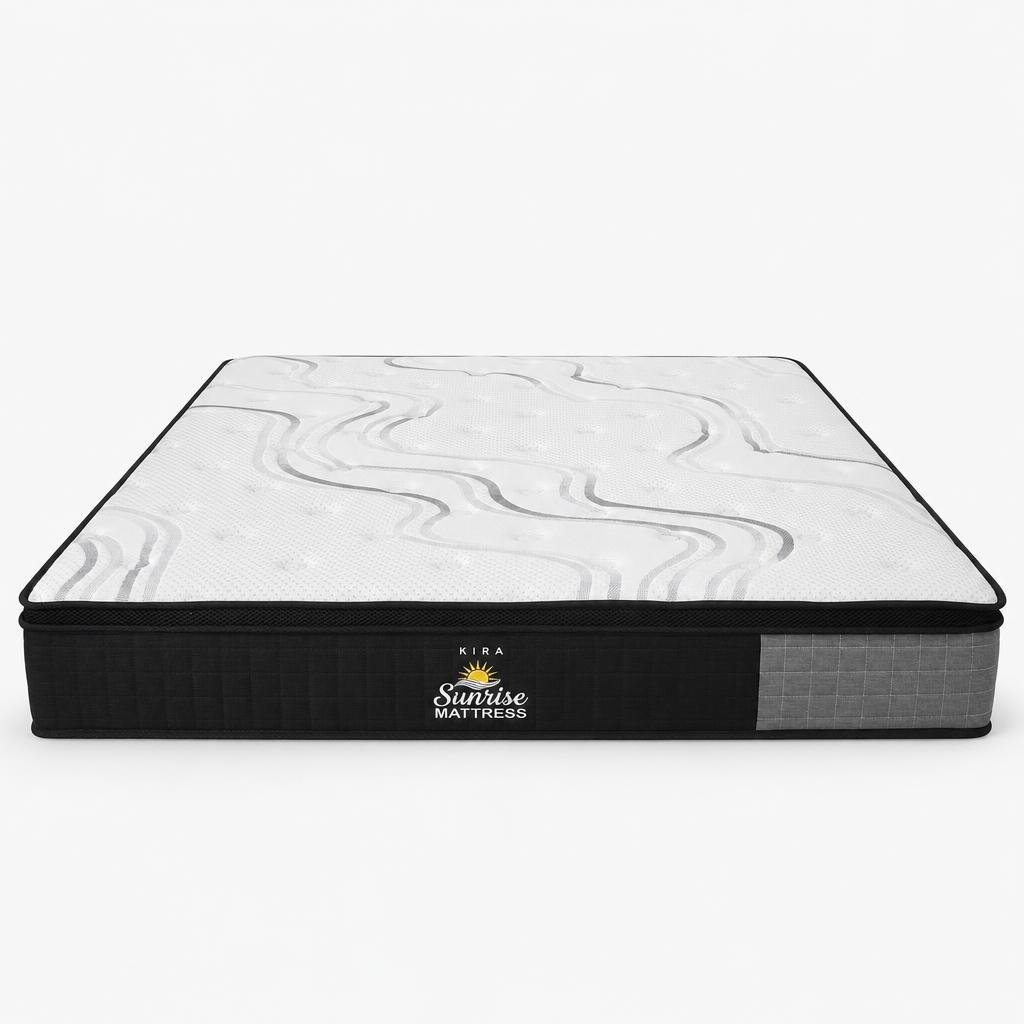
Why we built a 5-zone spring core
The Sunrise is a 5-zone mattress: its pocket-spring core is tuned to five different tensions across its length rather than one. Softer zones sit under your shoulders, where your body is broadest and needs to settle in. Firmer zones sit under your hips and lower back, where your body is heaviest and needs holding up. The remaining zones grade the transition so there's no ledge to feel between them.
Because every spring is individually pocketed, each one responds only to the weight directly above it. Your shoulder compresses its springs without dragging the hip zone down with it, and a partner turning over at 5am compresses theirs without echoing across the bed.
We'll be honest about the economics, because it explains why zoned cores are still rare here: a 5-zone core costs meaningfully more to manufacture than a single-tension block. It was the most expensive line on the Sunrise's build sheet, and it's the one we'd pay for again first, because it's the difference between a mattress that has a firmness and a mattress that has the right firmness in the right places.
The layers above the springs
Springs hold the line; the layers above them decide how getting there feels. In the Sunrise, three layers share that work.
The cooling gel memory foam is the contouring layer. It shapes itself to your shoulders and hips, spreading your weight across more of the surface so no single point carries too much of it. That's what pressure relief means in practice: nothing digging in, nothing going numb, less shifting around to get comfortable.
The adaptive comfort layer beneath it softens the first sink-in and then springs back. It's the layer that gives you close contact with the mattress without the stuck, moulded-in feeling that deep memory foam alone can produce when you try to change position.
The high-resilience support core is the floor of the system. It stops you sinking past the comfort layers and bottoming out onto the springs, and it keeps the surface stable so the zoned core underneath can do its work through every layer above it. Comfort layers without a support core feel wonderful for about a year; a support core built from high-resilience foam is why the Sunrise is designed to feel the same in year six.
Edge support: the part everyone forgets
Showroom tests happen in the middle of the bed. Real sleep happens everywhere else, especially in Sri Lankan bedrooms, where rooms run small and two people share a Queen. If a mattress goes soft at the border, you lose the outer strip of the bed on each side; you feel the slope and drift inward all night without knowing why.
The Sunrise wraps a firmer spring perimeter around all four sides. Sleep at the border and it holds you level instead of rolling you off. Sit on the edge to put your shoes on, and it takes your weight without collapsing. In practice, reinforced edge support means the mattress you paid for is the size of the mattress you sleep on: the full width, corner to corner.
One system, one restful night
None of these parts earns its place alone. The 5-zone core sets your spine in a neutral line; the comfort layers make that line feel like rest instead of discipline; the support core keeps both doing their jobs for years; and the reinforced edge extends all of it to the border of the bed. That's what we mean by support: not hardness, but a system tuned to hold your whole body properly, all night, so you can get a genuinely restful night's sleep and get up ready for the day.
If you want the story of how these layers were chosen, and what we rejected along the way, it's in how we chose the Sunrise's layers. And remember that any new mattress, however well-tuned, takes a few weeks to feel like yours.
If you're unsure whether the Sunrise's medium-firm feel suits how you sleep, message us on WhatsApp and we'll talk it through before you order. We'd rather get you into the right mattress than just any mattress.